


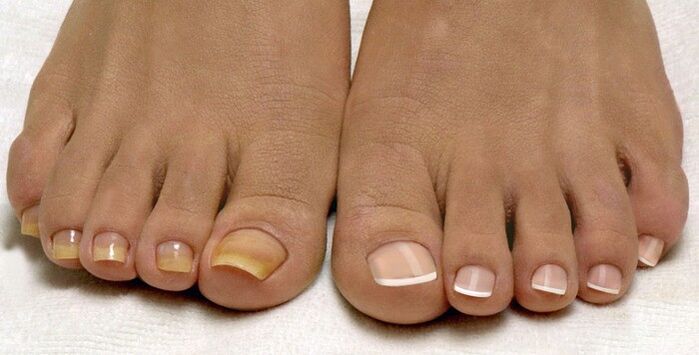
Fungus affecting the toenail plate is an infectious disease caused by fungi.Today, there are more than 50 pathogens, which complicates the classification of this disease;This article discusses the most common types, as well as ways to get rid of this pathology.
Cause
The cause of toenail fungus infection is infection with pathogenic organisms;Their penetration can occur in three main ways:
- Penetration under the edge of the nail plate and subsequent deepening, this path is the most common.
- Penetration through the back of the nail is observed in rare cases, as it is not accessible to all mycotic organisms.In such a situation, the development of the pathological process occurs faster.
- Penetration through the proximal ridge is also relatively rare and occurs most often in the arms rather than the legs.
Often, infection with fungal organisms occurs under the influence of the following provoking factors:
- Mechanical injury that leads to the destruction of the nail plate.
- Excessive use of degreasers or cleaning products that contain harmful components;Systematic relationship with water.
- Wearing inappropriate and uncomfortable shoes, as well as things made of synthetic materials, which create favorable conditions for the proliferation of pathogenic microflora.
- Increased sweating, regardless of the cause.
- Flat feet.
- Anatomical features of foot development, in particular, the presence of too narrow a space between the toes, which interferes with natural air exchange.
- Lack of hygienic foot care and too much nail clipping.
- Damage to the immune system.
- Tendency to varicose veins.
- Often wear warm clothes or shoes due to the climate in this region.Living in a subtropical climate also increases the risk of developing fungal diseases, because warm temperatures and high humidity are good factors for the reproduction of these organisms.
- Advanced Age.Changes in the body of the elderly increase the possibility of infection.
- Carrying out work activities in unfavorable conditions, including gassy and dusty rooms, physically demanding work, high humidity and frequent contact with chemicals.
- Diseases of the gastrointestinal tract, diabetes mellitus, obesity, disorders of natural metabolism, HIV infection, thyroid gland damage.All of these health problems put a person at risk.
- Long-term use of strong antibacterial agents and hormonal pharmacological drugs.
- Visit public baths, saunas and swimming pools.
- Shared Use of Shoes and Personal Care Products.
- Undergoing various cosmetic procedures where instruments are used that have not undergone appropriate treatment.
Types and symptoms
The symptoms that occur when the toenails are affected depend on the type of fungus and the causative agent of the disease.
The main types and their characteristic clinical picture are described below:
- Normotrophic fungi.The main symptom is a change in the color of the nail plate;Its thickness and structure are not subject to pathological processes.In the early stages, white or yellowish stripes and spots are formed, which are localized on the sides.If left untreated, they begin to grow and cover the entire nail.
- Hypertrophic fungi.With this disease, not only a change in color, but also an increase in the thickness of the plate is observed, which is associated with accelerated skin growth under the nail.Gradually, the loss of healthy shine occurs and the fragility of the nails increases, which begin to color even with the slightest pressure.First, the lateral area is destroyed, but if not treated, a general deformation is observed, as a result of which the nail begins to resemble a bird's claw in appearance.
- Atrophic fungi.The first symptom of this pathology is discoloration: the nail plate takes on a brown-gray color.Soon the natural shine disappears, and gradual destruction takes place.If left untreated, the progression of the disease leads to exposure of the nail folds and tissue necrosis.
- Lateral and distal fungi.Both of these types lead to the formation of transverse grooves with a yellow color, and parallel to this, dullness of the surface of the nail plate is observed.If the causative agent is mold, the affected area may be green or black.The weakness gradually increases, the plate structure becomes uneven and rough.After the affected area dies, the nail becomes deformed and the nail fold becomes partially exposed.This pathology can bring severe physical discomfort to the patient and cause constant pain if swelling and redness of the skin ridge occurs.
- Proximal fungi.This type of disease is very rare;In the early stages, the area around the skin folds is affected.The main cause of pathology is the side effect of cuticle removal, after which the area of the plate near the growth zone acquires a characteristic white color.The localization of lesions is associated with the characteristics of the spread of fungal spores;They gradually capture the entire nail plate.
- Amount of fungiOccurs in the absence of treatment for other forms of the disease, in this case there is a change in color and increased fragility, which gradually leads to the loss of the nail.
- White shallow fungus.The main symptom is the appearance of white spots localized near the posterior cushion.In the absence of proper treatment, the pathology progresses, and the wound begins to spread to neighboring areas.Often, a large number of small spots are formed, combining into a single pattern that looks like scattered powder.
Fungal stage
Regardless of the type of disease-causing agent, the nail plate is never completely affected.Pathological development occurs gradually, which allows us to distinguish the following stages:
- In the early stages, the wounds are localized in separate areas,Often they are side or free edge.At this stage, fine stripes or spots form, which are often invisible to a person.
- In the normotrophic lesion stage, pathological changes become significant,Traces of fungus can be detected even with the naked eye.There is also an increase in nail fragility and changes in its shade;In some forms of the disease, serous discharge can protrude from under the plate.
- In the hypertrophic lesion stage, the pathology continues to develop in the subungual space, which leads to plate thickening.Depending on the form of the disease, deformation, separation, thinning, lack of natural growth, and other types of destruction may occur.
Before the initial stage, a person often experiences problems with the skin of the feet: severe itching, burning, or cracking of the upper layer of the epidermis can be observed.Due to the lack of a clear clinical picture, diagnosis and making an accurate diagnosis at this stage is almost impossible.
In advanced stages, the disease actively develops;Symptoms spread not only to the toenails, but also to the plates located on the hands and skin.

How to treat at home?
At the initial stage, you can get rid of this disease using traditional medicine, but such measures must be agreed with a specialist, otherwise there is no risk of harm to your health.Some effective techniques are described below:
- Iodineis the most common drug, it is used for application to cotton swabs and subsequent treatment in the affected area, and also as an additional component for foot baths.
- Vinegaris another very effective remedy, because almost all fungal pathogens die in an environment with high acidity.It can be used pure or diluted in water and then applied directly to the affected area.
- Salicylic acidEffective in treating any form of fungus, used in the same way as vinegar.
- Eucalyptus or Tea Tree Essential Oil.Both of these drugs have a strong antiseptic effect, but are usually included in complex therapy.
How to get rid of foot fungus with medicine?
If the first symptoms of a fungal infection occur, it is recommended to immediately seek professional medical help, because only diagnostic measures can make an accurate diagnosis, and taking measures at an early stage allows you to quickly get rid of the pathology and minimize the risk of unwanted consequences.
Specialists usually prescribe pharmaceutical products, which can be produced in various forms.
Prevention
It is impossible to protect yourself from fungus, but the preventive measures described below significantly reduce the risk of infection:
- Maintaining a healthy lifestyle, hardening, ensuring a balanced diet, taking vitamins if they are deficient, playing sports and other measures to strengthen the immune system.
- Wear shoes when at the beach.
- Wear special closed rubber slippers when visiting the bath or sauna.
- Wear socks made only from natural materials and change them every day.
- Wear only your own shoes.
- Dry your feet thoroughly after showering to ensure they are completely dry.
Reviews
- I have had fungus on my toenails for a long time.I tried iodine and vinegar, but the effect was temporary.Only fungicides helped me.I applied the cream to my nails for several days, and soon realized that the disease was slowly receding.
- I saw fungus recently;Apparently I took it when I showered after working out.Therefore, swim only in flip-flops and do not go barefoot anywhere.Fungus is a difficult infection to get rid of.I use antifungal medicine, it helps.But along with it he applied vinegar to the affected area.Everything together gives great results.
- And this is not the first time I have struggled with fungus.It's so hard to leave me.I use various drugs that do their job perfectly.
- This fungus is a very unpleasant thing.Especially in summer!You are embarrassed to go somewhere, but I use an antifungal agent for external use, it has helped me a lot.If you catch a fungus once, the probability of it appearing a second time is 70%.Be careful!